
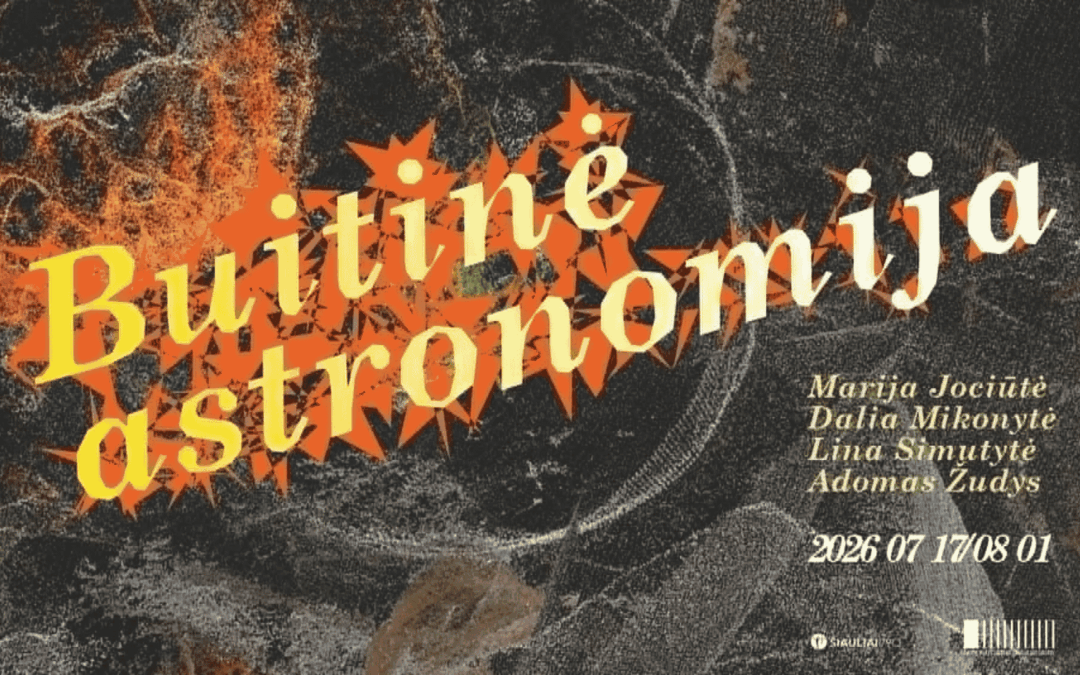
2026 m. liepos 17 d., penktadienį, 17.00 val. Šiaulių dailės galerijoje atidaroma Marijos Jociūtės, Dalios Mikonytės, Linos Simutytės ir Adomo Žudžio paroda „Buitinė astronomija“.
Paroda veiks iki rugpjūčio 1 d.
APIE PARODĄ
2019-ieji į astronomijos istoriją įrašyti kaip metai, kai pasauliui buvo pristatyta pirmoji juodosios skylės nuotrauka. Ji buvo sukurta pasitelkus skirtinguose planetos taškuose išdėstytų teleskopų surinktus duomenis ir radijo interferometrijos techniką. Ši technologija leido išgauti efektą, primenantį milžinišką teleskopą, kurio dydis prilygsta atstumui tarp realių teleskopų. Nors stebėjimai buvo atliekami nuo Havajų salų iki Antarktidos, atskiri duomenys buvo sujungti į vientisą vaizdą. Taip juodoji skylė tapo dar vienu vizualiniu atskaitos centru becentrėje Visatoje.
Projekte „Buitinė astronomija“ menininkai analizuoja juodosios skylės vizualumo fenomeną, jį interpretuodami ir perkurdami per asmenines kosmologijas. Kūrybiniame procese pasitelkiama taškų debesies estetika, analoginė fotografija, fotokoliažas, fotogrametrija ir kitos 3D technikos, poetinės prozos bei garsinių peizažų elementai. Kasdienė buities aplinka, tarsi ozono sluoksnis supanti žmogų, čia virsta nepažįstamais astronominiais artefaktais.
Artimiausio akiračio objektai dematerializuojami tam, kad netrukus įgytų naujas gyvybės formas. Modifikuodami daiktus, menininkai flirtuoja su buitimi ir būtimi. Parodą sudaro fotografiniai koliažai ir vaizdo projekcijos. Namų apyvokos reikmenys, tekstilė, technikos prietaisai, virtuvės įrankiai, augalai ir šviesos šaltiniai tįsta, trupa, atsiskiria ir vėl susijungia. Knygos, vinilinės plokštelės, praeities ir ateities kūriniai sukasi aplink savo ašį ir verčiasi per galvą. Gylis tampa apverstu aukščiu, o kiekvieną juodą paviršių subraižo baltumos laukimas.
Nors į „Buitinės astronomijos“ kūrybinį procesą įsilieję muzikos ir literatūros elementai gali veikti kaip savarankiški kūriniai, parodoje jie susitinka ir kalbasi, kviesdami tyrinėti šiuolaikinio menininko tapatybės klausimus. Skirtingos medijos šiame projekte veikia tarsi skirtinguose planetos taškuose stūksantys teleskopai. Milžinišką atstumą tarp jų įveikia buitinės astronomijos efektas: ištirpdydamas asmenines menininkų kūrybinių teritorijų ribas, jis skirtingus stebėjimus paverčia vientisais objektais.
APIE MENININKUS
Marija Jociūtė – Vienoje gyvenanti menininkė ir kompozitorė. Vilniuje baigė Fotografijos ir medijos meno bakalauro bei magistro studijas, nuo 2023 m. studijuoja elektroakustinę ir eksperimentinę muziką Vienos muzikos ir scenos meno universitete. Kūryboje ji tyrinėja elektroninio garso galimybes, pasitelkdama sintezatorius, garso įrašus, kompiuterines manipuliacijas ir vokalą.
Dalia Mikonytė – menininkė, fotografė, dėstytoja, Lietuvos fotomenininkų sąjungos ir Lietuvos tarpdisciplininio meno kūrėjų sąjungos narė. Jos kūryboje svarbios atminties, archyvavimo, intymios erdvės ir laiko temos. Menininkė dirba su fotografija, videomenu, 3D technikomis ir fiziniais artefaktais. Daugiau informacijos: www.daliamikonyte.lt
Lina Simutytė – rašytoja, scenaristė, literatūrinio projekto „Blunkanti sofa“ autorė. Jos debiutinė novelių knyga „Miesto šventė“ pelnė Jurgos Ivanauskaitės ir Kultūros ministerijos Jaunojo menininko premijas. Autorė dirba kultūros žurnalistikos, socialinės komunikacijos ir kūrybinio rašymo srityse, jos tekstai versti į anglų, vokiečių, olandų, lenkų, kartvelų, latvių ir kitas kalbas.
Adomas Žudys – menininkas ir Vilniaus dailės akademijos meno doktorantas, kuriantis skaitmeninių ir fizinių artefaktų sankirtoje. Jo kūryboje nagrinėjami materialumo, technologijų, tapatybės, suvokimo ir atpažinimo klausimai. Menininkas aktyviai dalyvauja tarpdisciplininio meno parodose ir renginiuose Lietuvoje bei užsienyje. Portfolio: www.zudys.lt
_ _ _
_ _ _
On 17 July 2026, Friday, at 5:00 p.m., the exhibition „Domestic Astronomy” by Marija Jociūtė, Dalia Mikonytė, Lina Simutytė and Adomas Žudys will open at Šiauliai Art Gallery.
The exhibition will run until 1 August.
ABOUT THE EXHIBITION
The year 2019 entered the history of astronomy as the year when the first photograph of a black hole was presented to the world. The image was created using data collected by telescopes located in different parts of the planet and the technique of radio interferometry. This technology made it possible to achieve an effect resembling a giant telescope, whose size corresponded to the distance between the actual telescopes. Although the observations were carried out from the Hawaiian Islands to Antarctica, separate sets of data were combined into a single image. In this way, the black hole became yet another visual point of reference in a centreless Universe.
In the project Domestic Astronomy, the artists analyse the phenomenon of the visuality of the black hole, interpreting and recreating it through personal cosmologies. The creative process employs point cloud aesthetics, analogue photography, photocollage, photogrammetry and other 3D techniques, as well as elements of poetic prose and soundscapes. The everyday domestic environment, surrounding the human being like an ozone layer, is transformed here into unfamiliar astronomical artefacts.
Objects from the closest horizon are dematerialised in order to soon acquire new forms of life. By modifying objects, the artists flirt with the domestic and the existential. The exhibition consists of photographic collages and video projections. Household items, textiles, technological devices, kitchen tools, plants and light sources stretch, crumble, separate and merge again. Books, vinyl records, works from the past and the future spin around their own axis and tumble head over heels. Depth becomes inverted height, while every black surface is scratched by the anticipation of whiteness.
Although the elements of music and literature that have entered the creative process of Domestic Astronomy may function as independent works, in the exhibition they meet and converse, inviting the viewer to explore questions of contemporary artistic identity. The different media in this project act like telescopes standing in different parts of the planet. The immense distance between them is overcome by the effect of domestic astronomy: dissolving the boundaries of the artists’ personal creative territories, it transforms their different observations into unified objects.
ABOUT THE ARTISTS
Marija Jociūtė is a Vienna-based artist and composer. She completed her BA and MA studies in Photography and Media Art in Vilnius and, since 2023, has been studying electroacoustic and experimental music at the University of Music and Performing Arts Vienna. In her practice, she explores the possibilities of electronic sound through synthesisers, sound recordings, computer-based manipulation and voice.
Dalia Mikonytė is an artist, photographer, lecturer, and a member of the Lithuanian Photographers Association and the Lithuanian Interdisciplinary Artists’ Association. Her work focuses on memory, archiving, intimate space and time. The artist works with photography, video art, 3D techniques and physical artefacts. More information: www.daliamikonyte.lt
Lina Simutytė is a writer, screenwriter and the author of the literary project Blunkanti sofa. Her debut short story collection Miesto šventė received the Jurga Ivanauskaitė Prize and the Young Artist Award of the Ministry of Culture of the Republic of Lithuania. She works in the fields of cultural journalism, social communication and creative writing. Her texts have been translated into English, German, Dutch, Polish, Georgian, Latvian and other languages.
Adomas Žudys is an artist and a doctoral candidate in art at the Vilnius Academy of Arts, working at the intersection of digital and physical artefacts. His practice explores questions of materiality, technology, identity, perception and recognition. The artist actively participates in exhibitions and events dedicated to interdisciplinary art in Lithuania and abroad. Portfolio: www.zudys.lt